Somebody on the XRP Ledger wants to swap a tokenized money market fund for a yen stablecoin. Nobody is standing on the other side of that. There is no waiting crowd of yen stablecoin holders who happen to want a tokenized money market fund at three o’clock on a Wednesday.
The trade clears anyway, in seconds. How that works is the entire argument, and it is also the answer to the question that keeps coming back: if RLUSD exists, what is XRP for?
The matching problem
Airlines ran into this first, and hardest.
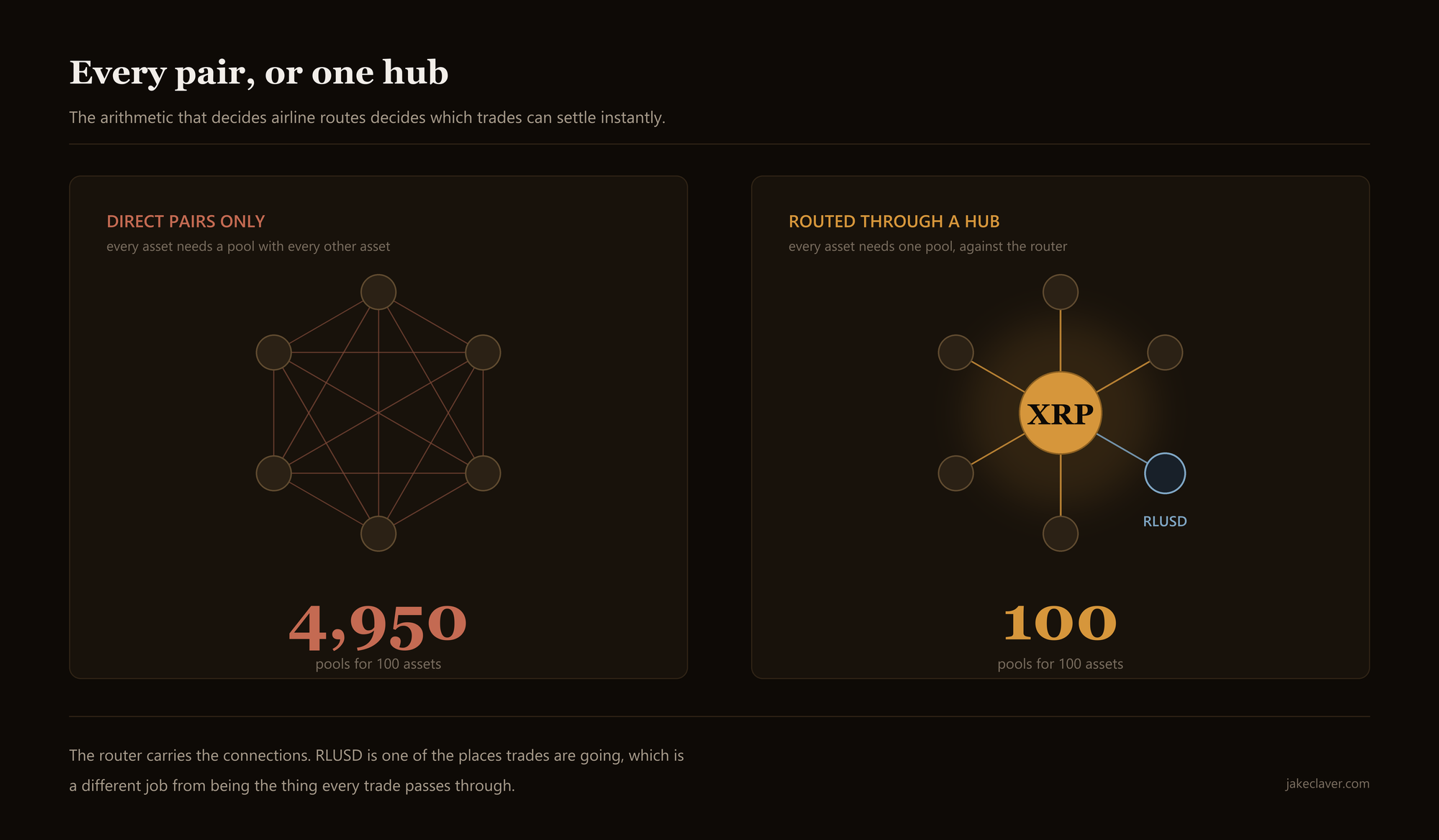
Serve 40 cities and there are 780 city pairs somebody might want to fly. Serve 80 and there are 3,160. Doubling the network quadruples the routes without quadrupling the passengers on any one of them. Most of those pairs would never fill an airplane. A network built only on nonstops buckles under its own arithmetic well before it becomes useful.
Exchanges have the same problem under a different name. Every asset added multiplies the pairs, and the odds that two specific counterparties want opposite sides of the same pair at the same instant fall away fast. Direct matching is fine in a market with six assets. It does not survive a market with six hundred.
What a hub actually does
Airlines did not fix this by adding nonstops. They fixed it by choosing a few airports and running everything through them.
Your ticket reads Fargo to Lisbon. The airplanes read Fargo to a hub, then hub to Lisbon. Two flights, one purchase, and you spend no attention on the middle. The trip exists because the airline never had to assemble 180 people in Fargo who all wanted Lisbon. It only had to fill one airplane out of Fargo and one into Lisbon, and let the hub sort the rest.
Back to the fund and the yen. The ledger does the same thing:
tokenized MMF → XRP → yen stablecoin
Two trades executed as one, in a single transaction, at a single price. The seller never sees the middle leg. The middle leg is the only reason there was a trade.
The job description
Before asking whether RLUSD can take this seat, write down what the seat requires. A hub is more than a busy airport. It has specific properties, and they are demanding.
Everything already connects to it. A hub is a hub because the network flies there. One with three routes is just an airport.
It stays open. A hub that closes strands its own traffic and every connecting itinerary in the system at once. Redundancy elsewhere is no help, because there is no elsewhere.
It admits everyone. A traveler changing planes never enters the country. Some passports still need a visa to sit in that terminal for two hours. A hub with an entry requirement serves the people who clear it and does not exist for anyone else.
Somebody keeps inventory there. Airlines park aircraft and crews at the hub overnight. Market makers do the equivalent: for a two-leg trade to feel like one, someone is holding the middle asset on their own book, continuously, across every pair they quote.
Now test the candidates.
RLUSD is a destination
RLUSD is a stablecoin: a token engineered to hold a dollar of value, with reserves at its issuer behind it. That is a valuable thing to be. It clears fast, it travels wherever the ledger goes, and it works on a Sunday when a bank dollar does not. Ripple’s stablecoin strategy is a serious piece of work, and BNY Mellon holding the reserves is the kind of arrangement that gets institutions comfortable.
It is also, structurally, a place trades want to end up. RLUSD is New York. Enormous numbers of trips are genuinely going there, and being a destination that popular is worth a great deal.
Where a trade has a dollar on one side, RLUSD is the right answer. Many trades won’t. A tokenized bond fund against a tokenized commodity. Collateral swaps between two non-dollar assets. Anything with something other than dollars on both ends. Those trips are not headed to New York, and they still have to get somewhere.
Run RLUSD against the job description and two of the four requirements fail.
It can close. RLUSD exists because a company issues it and holds reserves against it. That is what a stablecoin is. It also means the issuer’s problems become the token’s problems: a regulator, a banking relationship, a court order, a lapsed license. This describes how issued tokens are built. It is not an assessment of anyone’s balance sheet or conduct.
Carrying that exposure on one asset among hundreds is ordinary risk management. Carrying it on the asset every trade passes through is different in kind. A single company’s difficult week then cancels every connecting itinerary at once, with no rerouting available, because the route is what broke.
The overlooked version of this sits with the market makers. Someone has to warehouse the middle asset for the system to feel instant. If that asset is issued, every firm providing liquidity holds issuer exposure as a permanent working capital position, on every pair, indefinitely. Routing risk stops being something a trader accepts for eight seconds and becomes a balance sheet the whole market carries.
It has to be able to say no. Issuers are obliged to enforce. Sanctions screening, court orders, jurisdictional limits, wallet-level freezes, refusal to redeem. None of that is a flaw. A regulated dollar token is supposed to behave that way, and one that couldn’t would be the worse product.
It is simply incompatible with the routing seat. A settlement path on an open ledger has to clear between counterparties nobody screened and nobody vouched for. Put an asset carrying an enforcement obligation in the middle and you have built a hub with a transit visa.
“The dollar already does this”
This is the strongest objection to everything above, and it deserves to be met head on.
The dollar is the routing currency of global currency markets. The BIS Triennial Survey found it on one side of 89.2% of all FX turnover in April 2025, up from 88.4% in 2022, including vast volumes between two currencies that are not dollars. It has an issuer. It has been frozen. It routes the world regardless.
Three things separate that case from this one.
The environment differs. Dollar routing runs on correspondent banking, where screening is the product itself. Freeze capability is compatible with those rails because the rails were built to exclude. And they do exclude: entire regions have lost dollar correspondent access without a sanction anywhere in sight, because banks judged the compliance cost above the revenue. That is an observed failure mode.
The requirement inverts. A permissionless ledger clearing in seconds settles between parties who were never introduced. Adopt the dollar’s routing model and you inherit its gatekeeping, and what you have built is correspondent banking with better block times.
The comparison does unearned work. A dollar is an obligation of a sovereign with a central bank behind it. A stablecoin is a claim on a private company’s reserve account. Borrowing the first one’s track record to argue for the second skips the part that matters.
There is a fourth point, and the objection supplies it for free. When governments concluded the routing asset could be aimed at them, they started building around it. That reaction is this argument in miniature: neutrality in a settlement layer is load bearing, and everyone downstream notices when it is missing.
So which asset holds the seat
Every pool needs two different assets in it. Pair RLUSD with a euro token or with tokenized Treasuries and each of those pools has a non-dollar side. The question is which non-dollar asset the rest of the network converges on, because it will not be all of them. Capital and market maker attention are finite, and a market with hundreds of tokenized assets cannot fund a pool for every pair any more than an airline can fly every city pair nonstop. A few assets end up carrying the connecting traffic.
On the XRP Ledger, that has settled on XRP. Native pathfinding treats it as the default route. Market makers keep inventory in XRP pairs because that is where the flow already is. Few assets on the ledger trade against as wide a range of counterparts. And it has no mint, no redemption desk, and no balance sheet standing behind it, across more than a decade of operation.
The fair objection is concentration: Ripple holds a large position, much of it escrowed. True, and a real input to how anyone values the asset. It is a different question from the one routing turns on. Owning a great deal of something is not the same as being able to switch it off. No party can freeze XRP in a wallet, unwind a settled payment, or declare a counterparty ineligible to route through it. Concentration is a market structure question. Censorship is a protocol question, and the protocol has already answered it.
The same job description, twice more
Read those four requirements again and they describe something beyond trading.
Collateral. Post an asset against a loan and the lender needs it to survive three tests: it sells quickly near the last printed price, enough people want it that selling is not itself an event, and nothing outside the loan agreement can render it unusable before the loan closes. Fail the third and the lender is not secured, only hopeful. XRP is used as collateral in on-chain lending for the same properties that put it in the middle of trades: it moves in size, counterparties recognize it, and no third party can reach into the position while it is open. Where that position sits, and who else can reach it, is a custody question worth settling before the loan.
Escrow. The ledger can lock XRP for release at a set time or against proof of a condition, with no custodian involved and the protocol enforcing the terms. That covers token unlock schedules, coupon and payroll dates, staged payments in a negotiated deal, and any arrangement where one side performs before the other releases anything.
The property doing the work is the unglamorous one: what comes out is what went in. If the issuer can amend the terms of tokens already locked, the lock is a promise.
Two jobs
None of this argues against RLUSD. A market this size needs a credible digital dollar, and that is precisely what RLUSD is engineered to be. As the network grows, more trades will genuinely be going to New York.
More will be going everywhere else, and those still have to connect somewhere. Being the destination and being the connection are separate jobs. Both grow as the system does, and neither absorbs the other.
Which is why one does not replace the other.
Educational only, not tax, legal, or investment advice. Nothing here is a recommendation to buy, sell, or hold any digital asset. Check primary sources and speak with a qualified professional before making financial decisions.